

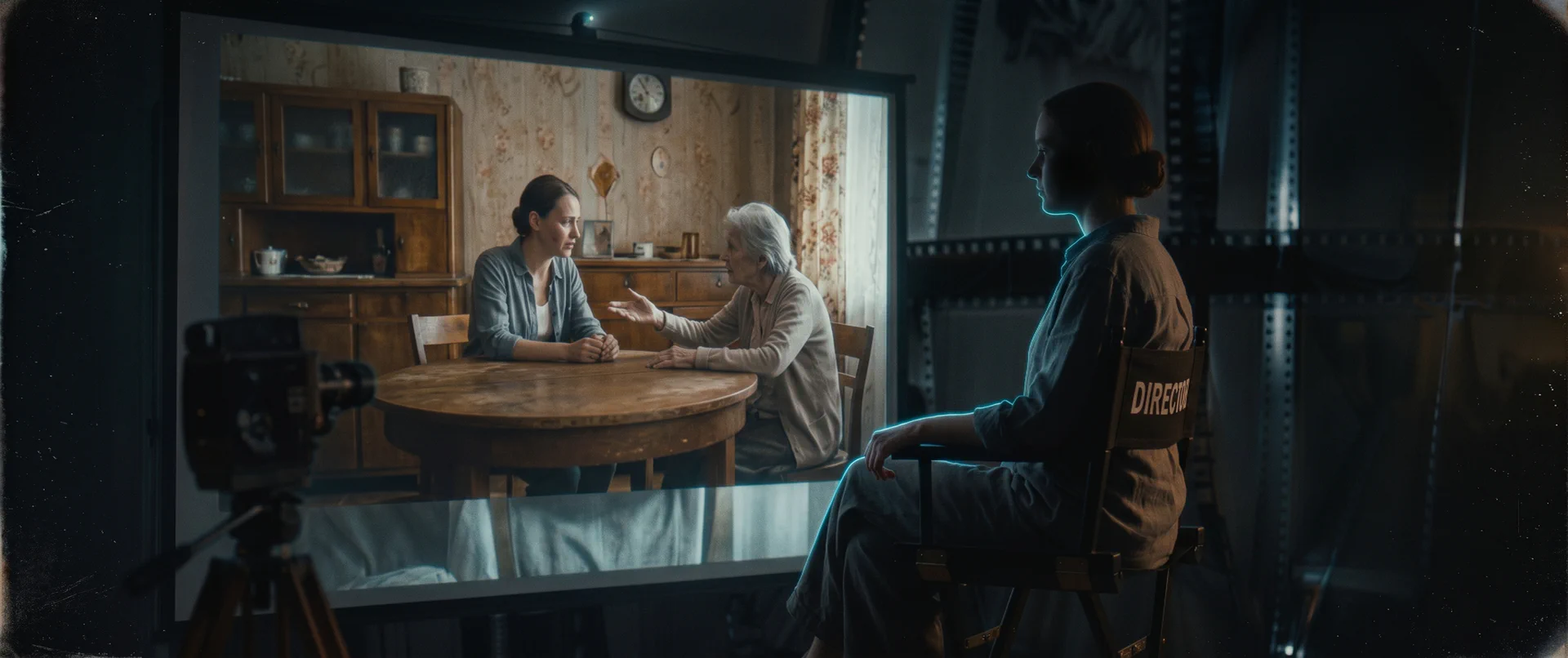
The Female Gaze – “Body and Camera: An Exploration of Contemporary Chinese Women’s Independent Filmmaking”
In Chinese-language independent cinema, first-person personal essays from a female perspective have always existed, yet they have often been marginalized and overlooked. Unlike traditional observational documentaries, women’s first-person documentaries and creative practices frequently proceed from the body, engaging through visceral, embodied experience in a process of continuous exploration. Female creators are often not merely objective observers but also intimate participants, persistently turning the lens back on themselves and repeatedly asking, “Who am I?” The eight works selected here, spanning 2020 to 2025, refract this questioning into contemporary women’s reflections on the self and on women of different generations — those women so routinely forgotten and neglected by society are precisely the ones who deserve our attention.
At the core of this program is the use of the body as a medium and first-person cinema as a method, making visible once more those forgotten, marginalized, and silenced dimensions of Chinese women’s experience. The camera becomes a bridge across women from different generations. This curation focuses on those invisible, peripheral women, giving them an opportunity to speak, to reveal themselves. From Dark Matters employs experimental imagery and voice-over to grant a grandmother who might otherwise have been forgotten the chance to speak. I Don’t Feel At Home Anywhere Anymore captures the profound sense of alienation felt by an overseas Chinese individual returning home.
Here, the body is not an object to be gazed at, but a direct bearer of history. Aging, childbirth, illness, death — in these works the body replaces text and narration, becoming the most truthful archive of women’s experience. Consider the body of the grandmother in her final days in A Worm Whatever Will Be, Will Be, who is convinced that worms are consuming her from within; the pregnant bodies of different women in Blessed with Burdens, or the body of director Li Xinyi jolted awake from a nightmare and vomiting from anxiety and the fear of death in Where am I heading, Where am I from?
In female personal filmmaking, the position of the “I” in these films is profoundly important, and simultaneously represents an exploration of women’s own subjectivity. Virtually all the films adopt a “first-person personal essay” approach. Whether documentary or experimental, the directors actively step into the frame and become the filmed subjects. In K872, the director appears repeatedly on screen in conversation with her mother and grandmother. In Frame, the creator places herself inside the image to express herself and interact. In I Don’t Feel At Home Anywhere Anymore, the director is both the protagonist and the “I,” leading us back to her homeland where she feels like an outsider, thus prompting reflections on the very definition of “home.” In Modern Masturbation Allegory, the director first reveals her own depression and inclination toward masturbation, which then unfolds into interviews with a diverse range of women.
Through this program, you will see the centrality of corporeality in women’s filmmaking. Historically, narratives have been dominated by the male voice, relegating women to passive objects. In these works, by contrast, you will find the embodied, lived expressions of mothers and grandmothers — figures so familiar to us yet so easily forgotten. In Chinese women’s first-person personal cinema, the camera becomes a medium, a bridge connecting generations and linking the filmmaker with the audience. This self-reflexive engagement with the medium itself — questioning whether the camera can capture objective truth, and actively exposing its limits — is a crucial shared characteristic of these works. To watch these films is to sense that women’s personal cinema is at the same time a more direct and more intimate archive.
Films in This Program


About the Curator
HanYing Du (KK) is a film practice researcher. She holds an MFA in Film and Television Studies from Boston University and a BA from Emerson College. As a female researcher and practitioner, her work has long centered on first-person documentaries that take the female body as their core subject.
Research work: Female Body as Method in First-Person Documentary: Toward an Embodied Epistemology in Zhang Mengqi’s Self-Portrait Series will be published in August 2026 in the Chinese Independent Cinema Observer (CICO).
Creative Work: Broken Stars (2022) has received 17 awards and nominations worldwide, including at LAFA, Top Shorts, the Red Film Festival (France), and the SENSEI Tokyo FilmFest (Japan), and has been featured in American Cinematographer and MovieMaker magazines.