

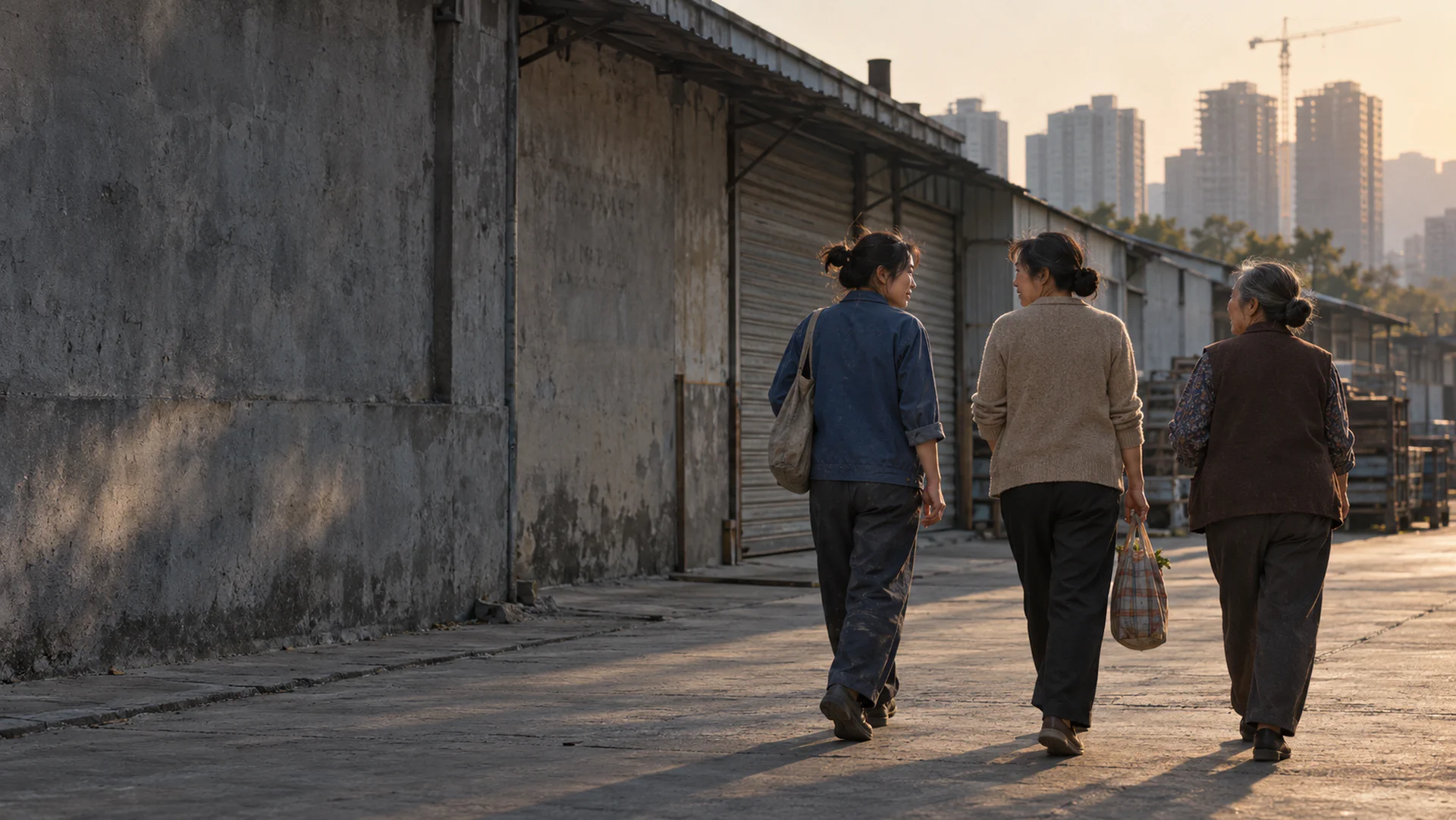
Women Passing Through an Era——Images of the Feminization of Poverty in China
The term Feminization of Poverty is commonly understood as an economic phenomenon, referring to the disproportionate likelihood that women experience poverty due to structural inequalities in income, employment, education, and social welfare. This film programme seeks to rethink the concept beyond its conventional definition. Here, poverty is not merely a lack of income or material resources. Rather, it describes a structural condition of life produced through China’s ongoing process of modernization, in which women continue to bear the social costs of labour, reproduction, caregiving, and migration, while remaining unable to accumulate resources of their own or exercise meaningful control over their bodies, their time, and their futures.
Since the launch of the Reform and Opening-up policy, China has undergone modernization at an unprecedented pace. The expansion of manufacturing, rapid urbanization, large-scale infrastructure projects, and the circulation of global capital have together shaped the dominant narrative of “development.” Growth, efficiency, and mobility have become the defining keywords of this era.Yet the story of development is most often narrated from the perspective of those who have benefited from it, while those whose labour, bodies, and everyday lives have sustained it remain largely unseen.
Spanning more than two decades, these films chart key moments in China’s modernization. Following Reform and Opening-up, the expansion of export-oriented manufacturing transformed the Pearl River Delta into the “world’s factory.” The Three Gorges Project reshaped landscapes, homes, and communities through one of the largest state-led resettlement campaigns in contemporary China. As market reforms deepened, women’s bodies became increasingly incorporated into the circuits of capital, reshaping the relationship between labour and value. Rural-to-urban migration gave rise to the experience of the left-behind generation, while the post-pandemic era profoundly unsettled the ways in which young people imagine the future. These historical transformations are not simply the backdrop to these women’s lives; they permeate their bodies, labour, emotions, and everyday existence.
Throughout the process of modernization, women’s poverty has not disappeared with development. Each transformation of the economic structure has reorganized women’s labour while reproducing new mechanisms of poverty. Modernization has not brought an end to women’s poverty; it has simply transformed the ways in which it is produced.
Poverty, then, is not simply a matter of insufficient income or material resources. Rather, it is a structural condition that runs throughout women’s lives: labour does not necessarily secure a future; care work rarely receives the recognition it deserves; migration does not always lead to a new life; girls are thrust into adulthood before they have finished growing up; and old age offers no guarantee of care or dignity. Women’s poverty is not a static condition. It is continually reorganized across different stages of modernization, assuming new forms as modernization itself unfolds.
These films do not ask how women become poor. They ask how women have continually made China’s modernization possible, while remaining unable to claim the future it promises. In addition, due to copyright or licensing restrictions, several films on this film list are currently unavailable for streaming on CathayPlay, including Laughing to Die (Tao Zhang, 2015), and New Moon Chapter One (Xinyue Li, 2024).
Non-Streaming Titles
- Laughing to Die (Tao Zhang, 2015)
Laughing to Die can almost be read as a parable of the Chinese family. The film is ultimately not about elder care, but about the complete reversal of a lifetime of care work. Having spent her younger years caring for others, the elderly mother eventually becomes a problem for the family to manage. The family has long depended on women to carry out the labour of social reproduction, while rarely recognizing such labour as labour in its own right. When care work remains excluded from systems of value, old age itself becomes another form of poverty.
- New Moon Chapter One (Xinyue Li, 2024)
As the only first-person film in this programme, New Moon Chapter One also serves as its conclusion. If the women in Houjie Township could still believe that leaving home might lead them toward a future, New Moon Chapter One confronts a moment in which the future itself has begun to lose its certainty. In the aftermath of the pandemic, growing up, working, falling in love, and even making films no longer seem to lead anywhere with confidence. The camera repeatedly turns toward the filmmaker herself, while continually questioning whether cinema is still capable of making sense of life. When development no longer promises a better future, poverty can no longer be understood solely in terms of income, labour, or the body. It becomes a condition defined by one’s relationship to the future. The film offers no answer. Instead, it leaves us with a question that remains unresolved: How do we continue to live when the future itself begins to blur?
Films in This Program


About the Curator
Hannah Liu is an independent curator and the host of the podcast Wander & Wonder. She has worked as a curator, assistant director, and producer, and now works as a barista while occasionally writing. She is interested in women’s experiences and lives that have yet to be fully told. She hopes to become a tree that keeps moving through the world.