

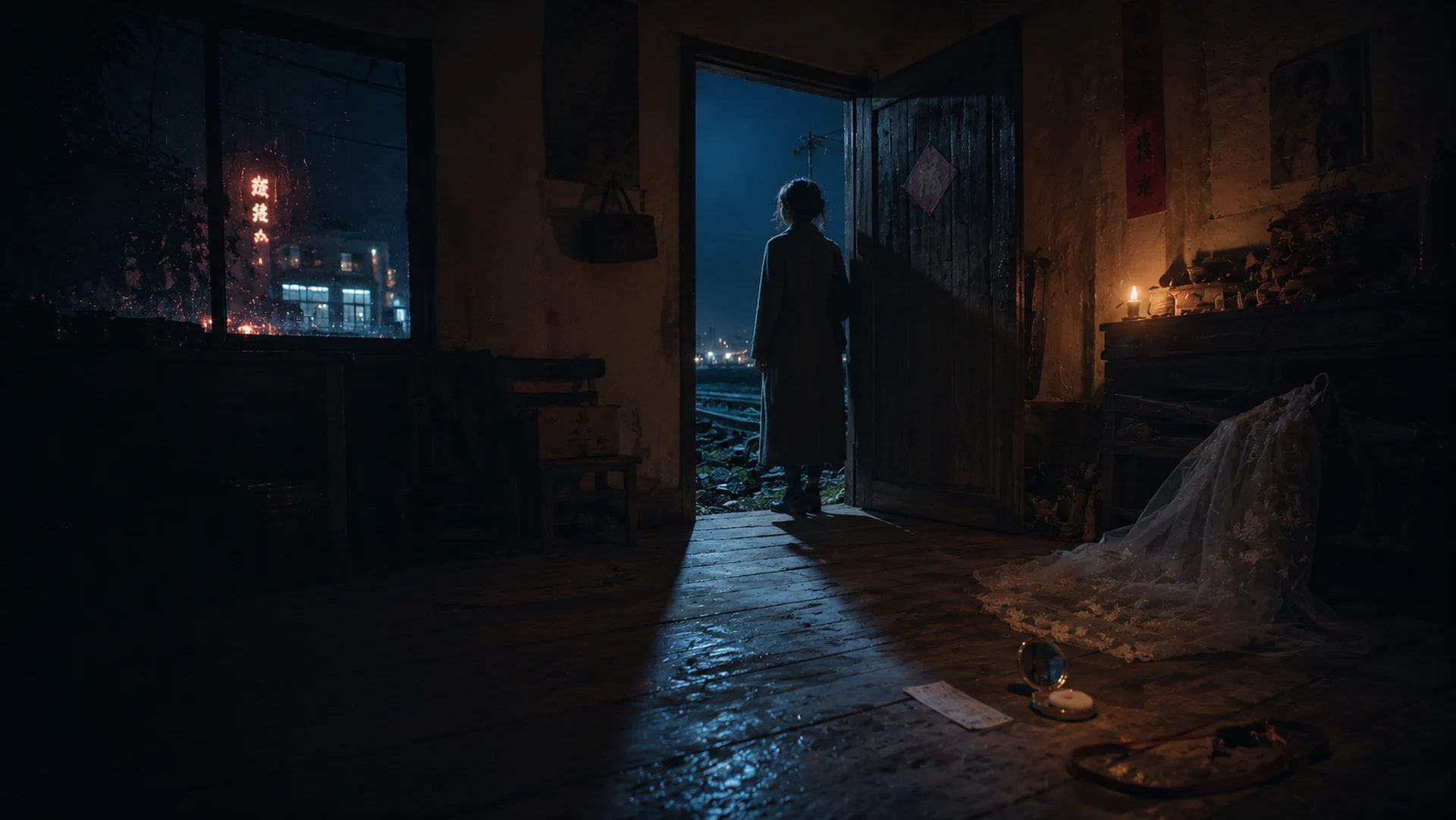
娜拉走後怎樣:東亞女性的「出走」、漂泊與新遊牧
1879 年,娜拉摔門而出,完成了女性自我意識的啟蒙;但在 1923 年,魯迅卻冷酷追問:「娜拉走後怎樣?不是墮落,就是回來。」——因為自由的底色,是真金白銀的生存博弈。跨越百年,在儒家倫理與資本化的東亞語境中,當代的「娜拉」們從未停止出走,但她們所面對的曠野已更變化莫測。
本次策展試圖以影像為坐標,追蹤那些出走的東亞女性足跡,凝視她們出走後的故事。選取的七部由女導演執導的作品,在劇情短片、人類學觀察與跨國私影像之間,勾勒出女性個體在家庭建制、經濟規訓與遊牧中突圍的複雜境況。
《有福氣》與《昨日新娘》對準女性「出走前夜」的枷鎖:前者撕開「生育祝福」的溫情表象,直視母親身份對女性生命空間的擠壓;後者則將遭遇家暴的妻子拽回昨日的婚禮現場,完成對「金絲雀命運」的叩問。《娜拉》與《新年舊日》刻畫了深陷鄉土與傳統家庭的女性,在面對「出走」時的踟躕與覺醒:一邊是農村主婦面對城市未知洪流時的恐懼與折返;另一邊是喪偶妻子在切斷婚姻羈絆後,借由重新拾起化妝與鋼琴,完成的一次無聲且向內的重建。《一夜雲泥》用底層敘事正面回應了魯迅的拷問,展現被邊緣化的農村婦女如何在性工作中奪回生活的掌控權;而《緬甸新娘:阿珍, 瑪用和喊愛的故事》與《外嫁新娘》則將「出走」的版圖推至跨國遊牧的維度。從扎根邊境、野蠻生長的緬甸母親,到無視偏見、在交友軟件上遠赴重洋尋找愛與保障的中國大媽——她們在異國他鄉與代際碰撞中,以近乎反叛的姿態,建立起非傳統的同盟與生存秩序。
在這份片單,我們將看到東亞女性「出走神話」背後的真實代價。浪漫的覺醒往往伴隨著恐懼與折返,而真正的自由,必將歷經底層的肉身博弈與世俗的殘酷洗禮。
七部影片,七種出走的形態。她們走出家門,卻發現門外是深夜的足療店、陌生的邊境線、無人理解的城市角落——或是那扇敲開又折返的房門。有人跨出去又退回來,有人走入了最黑暗的角落,有人在異鄉扎根,有人在丈夫去世後才慢慢找回自己。她們沒有一個是完美的勝利者,也並非純粹的悲劇人物——她們只是在各自的生存處境裡,做出了或大或小的選擇,然後承受其代價。
值得注意的是,這份片單的特殊性不僅在於「被凝視的女性命運」,更在於執掌鏡頭的雙手、發出凝視的目光,本身也屬於女性創作者。七部影片的導演均為女性。她們沒有將「女性力量」矮化為口號,也沒有用虛假的獨立神話去迎合某種消費主義的審美。在她們的鏡頭裡,身體的撕裂是具體的,生存的權衡是粗粝的,而那些看似荒誕、退縮、或沉默撫痕的選擇,都得到了最深沉的珍視。
這不僅是一份關於女性命運的記錄,更是一場女性創作者的集體表達與精神結盟。在東亞這塊土地上,當一個女性決定切斷「女兒、妻子、母親」的鎖鏈,她所面對的曠野是真實的,疲憊是真實的,傷痕也是真實的。但正是這些女導演們,用她們極具生命力的影像,在廢墟與曠野之上,誠實地搭建起了一間間「真正屬於她們自己的房間」。而這,或許比任何浪漫化的「出走神話」都更值得被看見。
未上線影片列表
- 回鄉偶記(冉玥,2026)
一部充滿張力與私人情感的家庭紀錄片。在瑞士結交到女朋友后,身為導演的女兒帶着攝像機回到中國,向傳統的母親坦白了自己的性取向。這場探討猶如多米諾骨牌,推倒了母親內心的防線。面對鏡頭,這位曾經離婚後又為了現實與前夫複合、背負巨額貸款的母親,不得不重新審視自己泥潭般的異性戀婚姻。女兒在性取向上的“出走”,無意中喚醒了母親對半生遭遇的深痛反思。 影片構成了一出精妙的雙重鏡像:鏡頭前是離家、出櫃並確立了主體性的女兒,鏡頭后是被困在門內、正在回望廢墟婚姻的母親。在兩人深夜對談的固定長鏡頭中,光影在兩代女性的臉上交錯。出走不再是單次事件,而是一場跨越代際、充滿陣痛的火種傳遞。
片單影片

When the protagonist’s cousin gives birth to a girl, her mother and family sigh outside the maternity ward: “Having a daughter is blessed.” But what exactly lies behind this “blessing”? Through a first-person documentary lens, the film delicately dissects the hidden pain women endure in childbirth, tearing away the warm facade of “maternal blessing” and capturing the countless compromises and sacrifices mothers make in shouldering motherhood.
Abandoning grand sociological narratives, the film uses extremely close handheld photography to capture cold medical instruments, torn flesh, and labored breathing, placing the traditional discourse of “blessed with a daughter” in brutal visual contrast. Before discussing the “departure” of East Asian women, this film serves as an essential pre-text: it shows how many invisible chains named “love and devotion” already bind Nora long before she reaches that door.

Beneath the veil of a perfect marriage, the wife “Meizi” lives a hidden and brutal life—she is a “canary” who has long endured domestic violence with nowhere to hide. On the eve of her decisive choice to leave home for good, a chance surreal moment sends Meizi, covered in wounds, back to the scene of her once-glorious wedding.
The director demonstrates remarkable control over spatial staging. The entire film uses low-key lighting and enclosed compositions, placing Meizi within shadows and geometric lines like a cage, pushing the suffocation of the “canary” to its limit. The camera lingers on her silence before the ruins of the wedding, visual oppression amplifying her inner turmoil without end. This is not an action-driven escape road movie, but a deep close-up of a woman’s psychology approaching the “breaking point” under structures of violence.

A film whose title is itself a declaration, directly echoing Lu Xun’s question. A rural wife trapped in a stifling marriage loves writing poetry in her spare farm work and even reads Lu Xun—already a vast temporal contrast. After meeting a female radio host from the city, she is invited to participate in a program. This is the “Nora-like departure” she has dreamed of, and her husband agrees to send her. Yet when she truly stands at the edge of the city, facing an entirely unfamiliar system, long isolation fills her with deep fear. In the end, she flees back to the village, avoiding the world outside the door.
The director skillfully captures women’s “loss of everyday speech” when confronted with the shock of modernity. Her retreat is not a lack of courage, but the psychological regression a Nora without economic and cultural capital inevitably faces before reality. Departure is sometimes not a lack of romantic impulse, but a lack of the practical capacity to step into the wilderness.

Housewife Huilin is accustomed to confiding life’s ups and downs to the Guan Gong statue at home. After her husband’s death, the grapevine she cherishes withers from over-fertilization, and her life arrives at a delicate crossroads through this “passive widow’s departure.” Unlike fierce rebellion and escape, the film uses extremely restrained camerawork to record an “inward departure.” She does not wail or rage, but quietly picks up long-forgotten hobbies—makeup, piano. Amid memory and release, with the gentleness and resilience particular to East Asian women, she quietly walks out of the ruins of her old life.
The film is filled with static, still-life-like fixed compositions. The director turns the camera toward floating curtains, withered grapevines, piano keys under fingertips—externalizing psychological time as visual still life. She does not leave the physical home, yet step by step she walks out of the ruins of identity as “wife” and “widow,” re-empowering herself within the wreckage of the old life.

A rural woman looked down upon in the city suffers exclusion while working in a big city. To raise medical expenses for her sick family, she finally enters an unlicensed foot massage parlor with no other way out. When her body is priced like fish on a chopping block, she does not fall into the total destruction of moralistic tales. Instead, with real economic income, the stalled “clock” of her life begins to turn again. In what the secular world calls “fall,” she exchanges survival and long-lost confidence.
The director uses long takes that are objective, restrained, and refuse the filter of pity, gazing at the protagonist’s labor in dim rooms. The body is thoroughly instrumentalized here. This refusal of sentimental audiovisual strategy forces viewers to confront the most visceral struggle of marginalized women between earning money, surviving, and reclaiming bodily autonomy.

In mainstream reports, they are often labeled victims of “trafficking and fraudulent marriage.” The director spent more than three months on site, using level-eyed footage to tear through stereotypes. They are “departures” across borders, laboring, putting down roots, and supporting one another on unfamiliar land. In the cracks of language barriers, awkward identity, and cultural conflict, they pave a path of survival with their bodies. This is among the most resilient samples of the transnational Nora in East Asia.
Through long-term observational filming, the camera records these women’s powerfully laboring bodies in border markets and fields. The audiovisual language is coarse with earth and sweat, showing how East Asian women in transnational movement forge informal alliances against structural oppression with tenacious vitality.

In traditional Chinese views of marriage, women over sixty who are divorced or widowed and have children seem already sentenced by the social clock to “emotional death.” Yet this film turns its lens toward four extraordinarily tough Chinese aunties. They may be ordinary mobile saleswomen in daily life, yet choose on Tinder to cross oceans seeking American husbands. Facing language barriers and surrounding prejudice, they remain true to themselves, attempting to “export” themselves to the other shore.
This is the most rebellious work in the program. With brisk editing and documentary humor in following shots, the film presents aunties’ proactive moves in the digital age and cross-cultural contexts. This absurdity precisely dissolves the invisible shackles East Asian society imposes on the group called “middle-aged and elderly women.”
About the Curator
卷卷,青年文化內容創作者,Indigo Estivate靛藍度夏主編。創作媒介跨越文字、影像與拼貼。